When Should You Change Transmission Fluid?
"Lifetime" fluid often means the life of the powertrain warranty, not of your car. Most owner's manuals list normal and severe service schedules, and manufacturer intervals run from 30,000 to 150,000 miles.
What Does "Lifetime" Transmission Fluid Really Mean?
No dipstick doesn't mean no service: a sealed transmission just hides the fluid, and some need changes as often as conventional units. BMW says the X5's fluid needs replacing only during repairs, yet ZF, which builds that transmission, recommends a change every 150,000 km, about 93,000 miles (see BMW repair in Los Angeles). Past 60,000 miles on "lifetime" fluid, have the shop check its condition and level.
Does LA Stop-and-Go Driving Count as Severe Service?
In most owner's manuals, yes. Short trips, stop-and-go traffic, idling, heat, steep grades and towing all count, and a summer I-405 crawl in Valley heat or a Grapevine climb stacks several at once. The common thread is heat: transmission overheating ages automatic transmission fluid (ATF) fastest. For CVTs (continuously variable transmissions), a common guideline is 60,000 miles in normal use, 30,000 in severe. If that's you, use the shorter interval, and check that your 60k service includes ATF.
What Should Your Transmission Fluid Look Like?
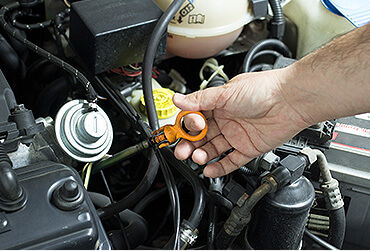
New ATF is red or pink, used fluid reddish-amber to medium brown. Dark brown or black means it's due, and milky or burnt-smelling dark fluid means diagnosis, not a change. Check a dipstick warm, after about 15 minutes of driving, and never overfill: excess fluid foams. Sealed units are checked at the check plug at a scan-tool-verified temperature (for Toyota WS, the temperature Toyota specifies for that transmission).
Fluid is the first suspect for delayed engagement (a lag before Drive or Reverse catches), harsh shifting or CVT shudder. Check engine light on too? Book a check engine light diagnosis.
Flush or Drain and Fill: Which Service Does Your Car Need?
A flush replaces the most fluid, which is exactly why it isn't automatically the safer choice. Quick-lube menus sell three different jobs under similar names.
Drain and Fill vs Pan Drop vs Fluid Exchange
| Method | What the shop does | Old fluid replaced (industry estimate) | Best for |
|---|---|---|---|
| Drain and fill | Opens the drain plug, refills the same amount | About 20-40% (5-7 quarts); the rest stays in the torque converter and cooler lines | Routine service, many CVTs, high mileage; repeat to refresh more |
| Pan drop and filter replacement | Drops the pan, renews filter and gasket, checks magnet debris | Same as drain and fill | Units with a serviceable filter |
| Fluid exchange (machine) | Hooks to the cooler lines; the transmission's pump swaps the fluid | Nearly all (12-22 quarts) | Healthy units, if the maker allows |
"Flush" ranges from this exchange to pressurized cleaning with additives, so ask. Some cars also need an adaptive values relearn afterward, a scan-tool reset of learned shift patterns.
Which Fluid Does Your Transmission Need: ATF or CVT Fluid?
Fluid that doesn't meet the OEM fluid specification can hurt shifting, shorten transmission life and complicate warranty claims. CVT fluid and ATF aren't interchangeable: in a CVT's steel belt-and-pulley drive, ATF can cause slip, shudder and failure. Typical specs (check your VIN):
- Many GM automatics use Dexron VI.
- Ford: Mercon LV in many 6-speed automatics; the 10-speed in most 2018 and newer F-150s takes Mercon ULV only.
- Toyota automatics, Camry included, run on Toyota ATF WS (see Toyota repair).
- Honda splits by type: Honda ATF DW-1 in classic automatics, HCF-2 in CVTs (some Accord years); Honda's own transmission fluids vary by year.
- Nissan CVTs, the Rogue's included, take NS-3, older ones NS-2.
- Manual transmissions need MTF (manual transmission fluid) or gear oil.
"Universal" ATF and "synthetic" labels don't replace the spec name.
Is a Fluid Change Risky on a High-Mileage Transmission?
A fluid change won't break a healthy high-mileage transmission, but it can worsen existing problems on a neglected one; some shops ask older-car owners to sign a liability waiver. Fresh fluid can't restore worn clutches, and an aggressive flush may push old wear debris into the valve body (the hydraulic controls). Untouched for 100,000+ miles but shifting fine? Inspect first (color, smell, pan magnet), then do a gentle drain and fill. Burnt fluid, metal or slipping needs diagnosis: see transmission repair or replacement.
How Much Does a Transmission Fluid Change Cost in Los Angeles?
Transmission care spans a fluid change, from $193 for a Honda Accord (RepairPal, Oct 2026), to a transmission replacement, from $6,238 nationally (RepairPal, Sep 2026).
| Job | Price | Source |
|---|---|---|
| Transmission fluid change | from $294 | RepairPal, Sep 2026 |
| Labor | from $131 | RepairPal, Sep 2026 |
| Parts (fluid, filter, gasket) | from $163 | RepairPal, Sep 2026 |
| Honda Accord | from $193 | RepairPal, Oct 2026 |
| Toyota Camry | from $254 | RepairPal, Oct 2026 |
| Ford F-150 | from $548 | RepairPal, Oct 2026 |
National estimates, before tax and fees and not adjusted for location; expect LA to land higher, since an average California labor hour costs $156 against $132 nationally (Tekmetric, 2026). The shop's written estimate is the final word. What moves it:
- Method: an exchange uses far more fluid.
- Fluid: brand-specific specs cost more than universal ATF.
- Filter: some sit inside the pan, which is replaced whole.
- Size and shop: pickups hold more than sedans (hence F-150 versus Accord), and dealers usually charge more per hour.
What Should the Shop's Estimate and Invoice Show?
California's Bureau of Automotive Repair (BAR) requires a written estimate before work; for fluid service it should list the method, fluid spec, quarts and any filter or gasket, and the invoice should match. If the drain turns up burnt fluid or metal, extra work needs your OK. Check the shop's ARD number at bar.ca.gov, ask about A2, ASE's automatic transmission test, and get the warranty in writing. Copperline's referral fee is paid per connected call, never by drivers (details: how to check an LA auto shop).
Get a free quote from a local shop
Free for drivers. You pay the shop only for work you approve.